


How Digital Marketing Is Directly Contributing To Climate Change

[ad_1]
The planet is on fire – and digital marketing is partly to blame, argues columnist Samuel Scott.
The earth has a finite amount of space and resources. Basing our companies, marketing models and entire economies on the need for continuous, neverending growth might not be the best idea.
After I graduated from university, my first full-time job in journalism in the US was as a staff reporter for The Boston Courant. The weekly newspaper covered the Back Bay, Beacon Hill, Fenway, and part of the South End neighborhoods in the city. Although the publication never really ‘grew’, it was seemingly very profitable.
What was the paper’s business strategy? Cover the richest parts of Boston, and charge companies a lot of money to advertise to the people who live there. (Former US senator and secretary of state John Kerry’s home is on Beacon Hill.)
‘Growth’ was not a part of the plan. If the Courant would have expanded into other, poorer neighborhoods, the average wealth – and thereby value – of the paper’s readership would have declined. The publication’s circulation remained constant while the publisher would increase profits by raising advertising rates periodically.
At a time when many companies care more about growth and less about profits, marketers could learn from that newspaper. For a moment, forget about ‘growth’. Forget that ‘digital’ is not a marketing strategy, tactic or channel but a type of technology. Forget that people calling themselves ‘growth hackers’ or ‘digital marketers’ are actually limiting themselves and telling the world that they can use only a small number of the available tools in the marcom toolbox.
The worst thing about ‘growth hacking’ and digital advertising today is that they are directly contributing to climate change.
‘Profitability does not matter’
At the peak of July’s first international heat wave, London (39 C) was hotter than here in Tel Aviv (32 C) for the first time that I can remember – if not for the first time ever. And it was not even August yet in the northern hemisphere.
But what worries me the most today is that there are seemingly few marketers who realize that there is a direct line from growth hacking to digital advertising to energy consumption to climate change. Let’s go back to the beginning.
It always starts with the money. A venture capitalist receives money from ‘limited partners’ such as endowments, corporate pension funds, sovereign wealth funds and wealthy families. He creates a VC fund and invests in various companies – typically, tech startups.
The goal is for the startups to grow as large as possible, as quickly as possible, and then exit through an acquisition or initial public offering (IPO) on a stock exchange. Then, the VC fund gets high returns for the limited partners. Profitability has nothing to do with it.
“When it comes to investors and getting an exit, how often does a startup get acquired because it was profitable? Rarely, if not never,” Mat Sherman, founder of the startup founder networking platform Seedscout, has written on Medium. “Startups get acquired because of the technology, product, team, or combination of the three.”
Enter ‘growth hacking’. By most accounts, the term was created in 2010 by Sean Ellis, the founder and chief executive of the software company GrowthHackers, to refer in part to getting customers or users quickly and cheaply in the tech world.
In his 2014 book Growth Hacker Marketing, Ryan Holiday described the practice this way: “A growth hacker is someone who has thrown out the playbook of traditional marketing and replaced it with only what is testable, trackable and scalable. Their tools are emails, pay-per-click ads, blogs and platform APIs instead of commercials, publicity, and money.” That sentiment has since spread from the tech world to marketers in many other industries.
The VC-funded startup world cares only about quick growth, so ‘growth hackers’ care only about what is quickly ‘testable, trackable and scalable’. The problems with that mentality in marketing are best reserved for another time. The issue here is that ‘growth hacking’ means using only digital tools and channels – nearly all of which are now based on cloud computing.
The energy consumption of cloud marketing
At a basic level, ‘the cloud’ is a buzzword for the world’s interconnected IT infrastructure of network devices, data centers, cell towers and fiber optic cables that are usually owned by various companies. Using ‘the cloud’ is outsourcing one’s IT by renting space there.
On the positive side, cloud computing – which became mainstream in the mid-2000s – can be cheaper, faster and more secure than using one’s own servers. Much of the speed and ease at which marketers can engage on social media, send email newsletters or run programmatic ad campaigns comes from this infrastructure.
A post at the educational platform Cloud Academy puts it this way: “With the use of cloud-based tools, marketers have better control over marketing and business content. They can deploy strategies independently without having to rely on other departments, which definitely streamlines the operations and saves time… The automation of marketing operations strengthens the core of the business as a whole.”
But on the negative side, the cloud’s infrastructure consumes a lot of energy. You know how hot a laptop can feel? Multiply that by the estimated 2bn computers that are in the world.
Writing in the digital magazine Aeon last month, MIT cloud anthropologist Steven Gonzalez Monserrate noted the cloud’s “titanic electricity requirements, the staggering water footprint required to cool its equipment, the metric tons of electronic waste it proliferates … to keep data centers – the heart of the cloud – operational 24 hours a day, seven days a week, 365 days a year.”
The effect is more than theoretical. According to the Financial Times in July, the Greater London Authority (GLA) has banned new housing developments in parts of the city’s West End because “there is not ‘sufficient electrical capacity for a new connection’ until up to 2035.”
The reason? Nearby data centers are using all the available power. “Data centers use large quantities of electricity, the equivalent of towns or small cities, to power servers and ensure resilience in service,” the FT quoted the GLA as saying.
In addition, The Register, a UK tech publication, recently reported that the largest US data center market – in Loudoun County, Virginia – is now running short on electricity. Recently, extreme heat in California knocked a key Twitter data center offline.
In total, worldwide data centers use 1% of global electricity consumption, according to the German business publication Deutsche Welle earlier this year. That is just under the annual electric use of Australia or Taiwan and more than the individual amounts used in South Africa, Argentina, or Colombia.
Many marketers often claim that we are now ‘living in a digital world’ and that marcom campaigns should be ‘digital-first’. But it is digital technology itself that is contributing to climate change.
Which advertising channels use the most energy?
Every single time that marketers use computers, mobile devices, anything digital or the internet in general, they are consuming electricity. According to Gary Nissim, managing director of the Australian agency Indago Digital, a website with 100,000 page views per month emits twice the amount of carbon dioxide per year as a Toyota Yaris.
In contrast, traditional billboards with paper or vinyl ads, for example, use essentially no energy. The Drum’s media editor, John McCarthy, recently reported on the controversial energy consumption of digital outdoor (OOH) ads after Greenpeace tweeted a picture of a vandalized Clear Channel six-panel display.
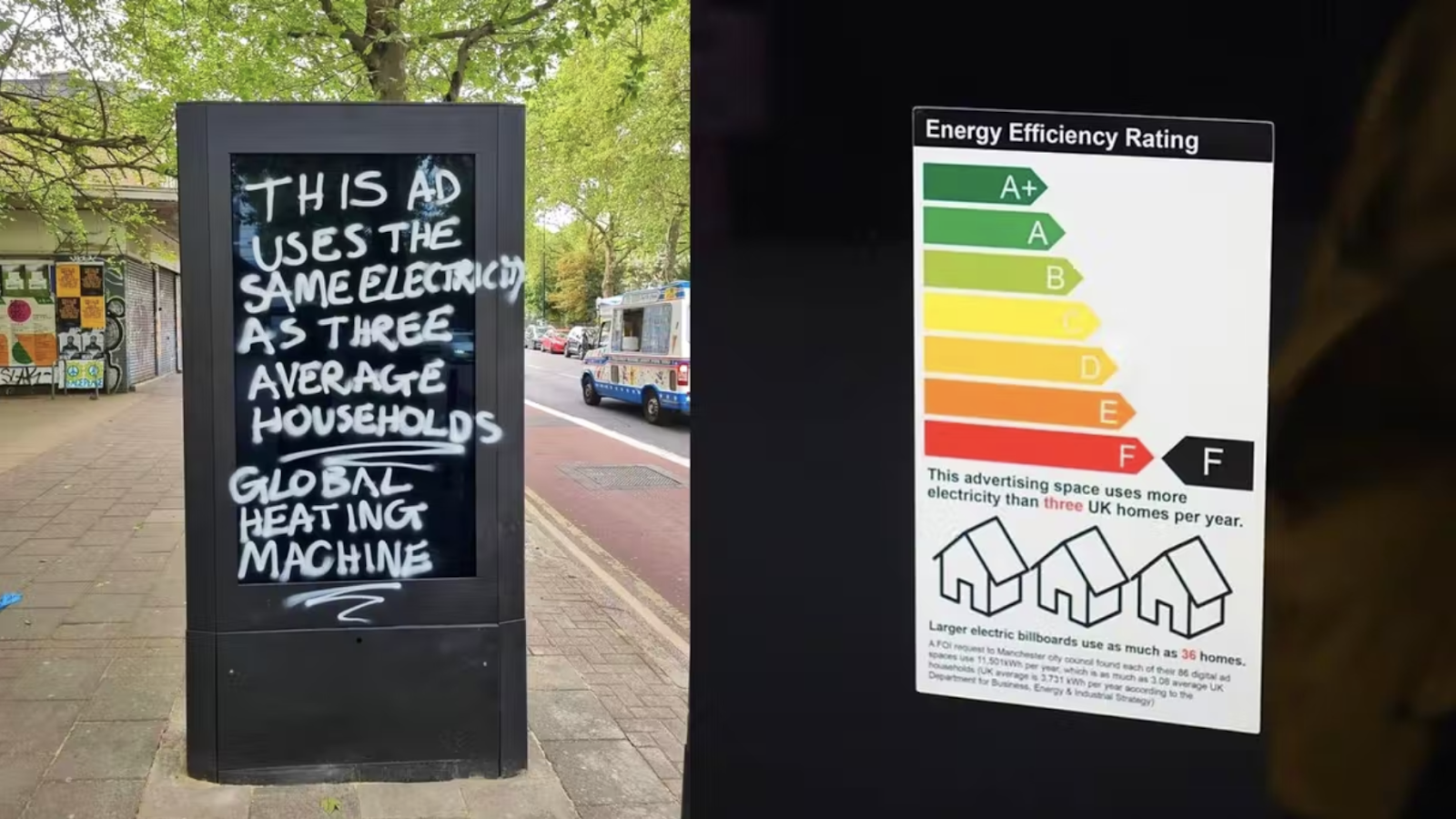
McCarthy cited research showing that a double-sided digital freestanding unit from Clear Channel used more electricity than four homes each year. A large JCDecaux billboard was found to consume up to the equivalent of 36 homes.
Scope3 is a new startup based in London and New York City that helps brands, advertisers and publishers to measure and reduce their carbon emissions. The company is led by Brian O’Kelley, the co-founder and former chief executive of the ad tech platform AppNexus before its $1.6bn sale to AT&T in 2018.
“In the advertising industry, there’s a hidden truth,” Anne Coghlan, another Scope3 co-founder, told me. “The by-product of new technologies, innovation and a constant need to drive revenue growth has created supply chains which are incredibly inefficient and ultimately harming our planet.
“Of the $500bn that marketers spend on advertising each year, nearly three-quarters of this is going towards digital ads. To quantify the problem, one million digital ad impressions generate an equal amount of carbon emissions as one round trip flight from Boston to London for one person. This has become a systemic issue embedded in complex supply chains.”
Noting the pervasive amount of fraud in the online advertising world, is it worth emitting such levels of greenhouse gasses to run display and programmatic ads that are often never seen by human beings?
In addition, Net Zero Media, an Australian emissions measurement company, found this month that marketing activities accounted for substantial percentages of corporate greenhouse gas emissions in the country.
For this column, I contacted the US and UK trade organizations that represent the TV, radio, print, outdoor, cinema and online advertising industries in those two countries. Only one – Outsmart in the UK – responded to my inquiries on the amounts of carbon emissions that ad campaigns on their respective channels emit.
“Media are not equal when it comes to their carbon impact,” Tim Lumb, the organization’s insight and effectiveness director, told me. “The weight and mix chosen for a campaign can make a big difference, and the one-to-many nature of OOH shows it to have the least impact for audience plays.”
“[Digital] OOH does not require the physical distribution of assets,” he added. “DOOH makes up 0.03% of all 100m digital screens in the UK.”
Still, I propose a test. In a prior column, I advocated for the use of controlled experiments to compare the true effectiveness of various advertising channels. Some neutral, trustworthy research firm or university should do something similar when it comes to traditional versus digital outdoor ads.
Take two similar areas in two similar cities in a country. In one, run an outdoor campaign for a given product with traditional billboards. In the other, use digital billboards. Make everything similar – from the product to the creative to the placements to the foot traffic. The only variable should be the use of digital technology or not.
Then, compare the metrics after the campaign – everything from sales lift to brand awareness to mental availability to share of search. The question to answer: does making a billboard ‘digital’ have any greater positive impact?
According to Enders Analysis, the portion of UK outdoor advertising that was digital rose from 10% in 2010 to 50% in 2018. But if it does not improve effectiveness, then ‘digital’ is even worse than a vanity metric – it is a vanity technology. (Just because something is newer does not automatically make it better.)
But if the shift to digital does increase effectiveness, then advertisers may have to choose between selling more stuff or saving the world.
Of course, the industry should do similar studies for all types of advertising. Remember: true brand purpose is not telling the world that you support a cause – it is actually doing something to help.
In the meantime, there are carbon emission tools that the industry can use such as the UK IPA’s Media Carbon Calculator, MediaCom’s Carbon Calculator and the AdGreen Carbon Calculator. But their accuracy is debatable. GroupM, WPP’s media investment group, also recently announced an initiative to measure and reduce ad-based carbon emissions.
Every marcom channel has positives and negatives to consider when creating media plans for advertising campaigns. The environmental impact is now one additional variable to keep in mind.
The big picture of economic sustainability
Herman Daly, an emeritus professor at the University of Maryland’s School of Public Policy and a former senior economist for the World Bank, is a noted opponent of economies based on constant growth and a proponent of what he deems a ‘steady-state economy’.
“In ecological economics, we’ve tried to make a distinction between development and growth,” he recently told The New York Times. “When something grows, it gets bigger physically by accretion or assimilation of material. When something develops, it gets better in a qualitative sense. It doesn’t have to get bigger.”
Just like my old newspaper The Boston Courant. (And unlike certain once highly-regarded business publications that have sacrificed their strong brands to grow by publishing more and more clickbait to get more and more traffic. The quality of an audience is often more important than the quantity.)
Now, imagine if the marketing and tech worlds adopted that same idea.
HubSpot was founded in 2006 and had a net income of -$78m in 2021. Airbnb started in 2008 and lost $352m last year. Uber? 2009 and -$496m. There are countless other examples. WeWork? 2008 and -$4.4bn.
Of course, there is nothing inherently wrong with being unprofitable – at least at the beginning. An inventor might live off a small bank loan while creating something in his garage. But there is something inherently wrong with huge companies that still lose hundreds of millions of dollars after a decade.
In such an environment, survival is not based on who builds the best products or does the best advertising – instead, it is based on who gets the most money from VCs. And that is unsustainable in every sense of the word. It is easy when money is cheap. After all, interest rates had been at near-zero levels since the Great Recession at the end of the 2000s.
But take the current stagflation environment that is seeing rising interest rates. Scott Galloway crunched the numbers and published in a recent email newsletter that large, unprofitable tech companies have been responsible for most of the stock market losses over the past year.
As examples at that time, he cited Snap (-86%), Peloton (-90%) and Roku (-80%).
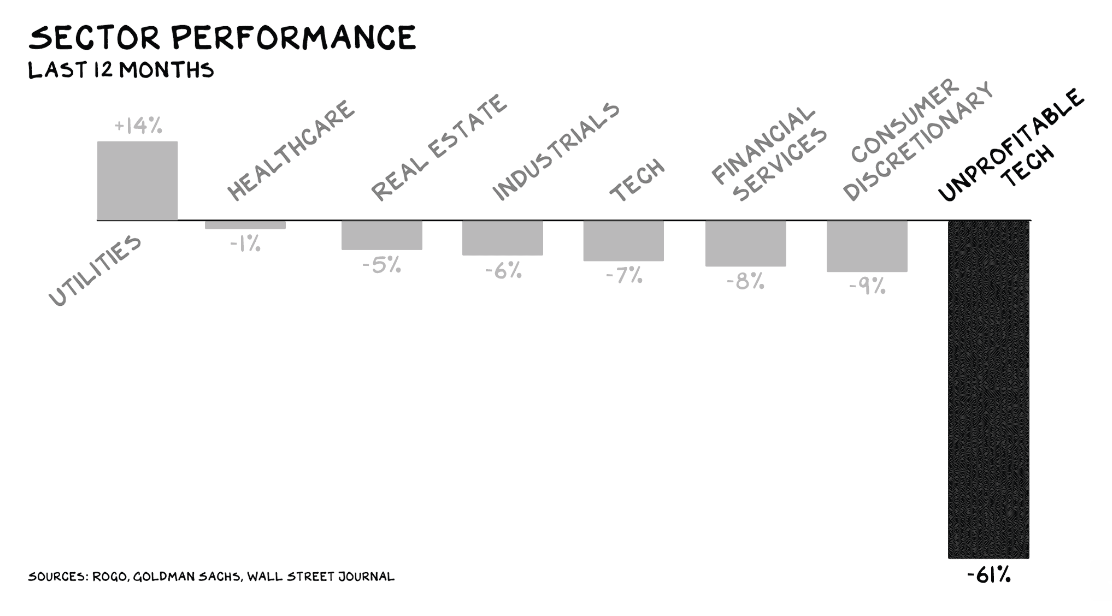
In my adult lifetime, I have seen three major downturns – each of which was largely caused by highly overvalued sectors: tech in 2000, mortgage-backed securities in 2008 and tech again in 2022. Economies with constant, erratic swings from skyrocketing highs to doldrum lows help no one.
“We will need another bubble to get to the multipliers and valuations we had in Q3 2021,” angel investor and Salto cofounder Benny Schnaider recently told the Israeli business publication Calcalist. But it is neither healthy nor sustainable for economies or industries to rely on bubbles reinflating over and over again.
“This uniquely 21st-century phenomenon has warped how technology companies view the fundamental tenets of business,” the product platform ProductPlan correctly notes in a company post. “Executives aren’t worried about profit margins, ROIs and sound fiscal fundamentals – it’s all about gobbling up customers like a high-stakes game of Hungry Hungry Hippos.”
And a further question: is the existence of so many unprofitable behemoths good for the climate?
At their best, corporations can help society in numerous ways. Employees earn salaries that they spend at other businesses. A company might invent a new product that benefits the world. Most importantly, they provide tax revenue that governments can use to build schools, fund hospitals and decrease carbon emissions.
But corporations that do not post profits generally do not pay any taxes. Therefore, they are the ones that help humanity the least. Business and marketing models that prioritize profitability – rather than top-line revenue – are the best for the world.
As London Business School finance professor Alex Edmans wrote in a post on Oxford University’s Faculty of Law blog in October 2021: “Sustainable profits are the sign of a responsible company.”
Soon, the marketing industry’s use of energy-consuming digital tools in service of profitless ‘growth hacking’ might become neither sustainable nor responsible. After all, self-serving, unrestrained growth is how cancer works. And it often kills the host.
The Promotion Fix is an exclusive column for The Drum contributed by Samuel Scott, a global keynote marketing speaker based out of Tel Aviv, Israel. His opinions are only his own.
[ad_2]
Source link


