


Community science draws on the power of the crowd

[ad_1]
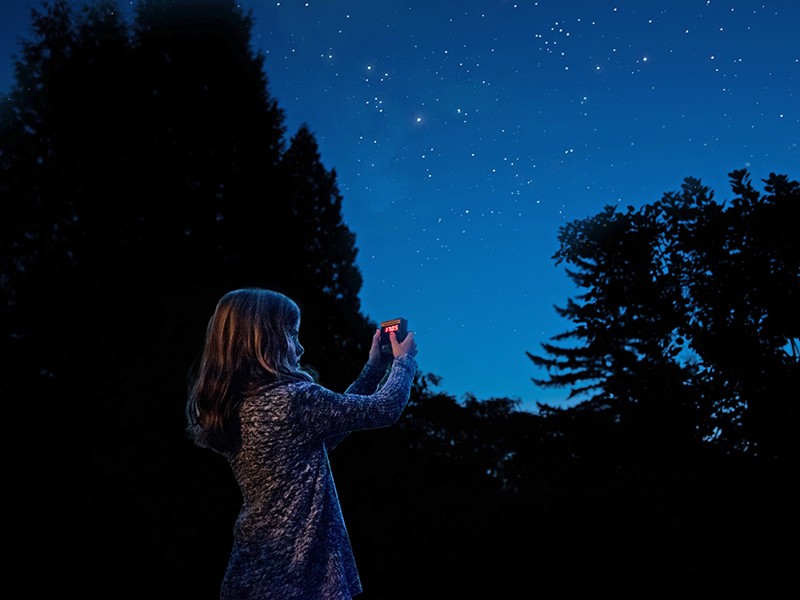
A community scientist uses a sky-quality meter to measure light pollution at night.Credit: Emily Maletz
For Greg Pauly, inspiration came in the form of roadkill.
Jogging in Los Angeles, California, about ten years ago, Pauly, the curator of herpetology at the Natural History Museum of Los Angeles County, was shocked to see a Southern California legless lizard (Anniella stebbinsi) being hit by a car. “I could not believe that this particular species of lizard would be in that neighbourhood,” he recalls.
What else might be lurking in Los Angeles back gardens? And how could Pauly possibly find out, given that so much of the crowded county is private property, inaccessible to scientists? Then Pauly had an epiphany. “All the people are not the problem — all the people are the solution,” he says.
Since 2013, Pauly has been engaged in a community-science project using the natural-history app iNaturalist. His network of 9,000-plus contributors has accumulated more than 60,000 reptile sightings, allowing him to identify and eradicate an invasive species, observe rare alligator-lizard (Elgaria multicarinata) matings and publish more than a dozen papers.
In community science, also called participatory science, non-professionals contribute their time, energy or expertise to research. (The term ‘citizen science’ is also used but can be perceived as excluding non-citizens.)
Whatever name is used, the approach is more popular than ever and even has journals dedicated to it. The number of annual publications mentioning ‘citizen science’ went from 151 in 2015 to more than 640 in 2021, according to the Web of Science database. Researchers from physiologists to palaeontologists to astronomers are finding that harnessing the efforts of ordinary people is often the best route to the answers they seek.
“More and more funding organizations are actually promoting this type of participatory- and citizen-science data gathering,” says Bálint Balázs, managing director of the Environmental Social Science Research Group in Budapest, a non-profit company focusing on socio-economic research for sustainability.
Community science is also a great tool for outreach, and scientists often delight in interactions with amateur researchers. But it’s important to remember that community science is, foremost, a research methodology like any other, with its own requirements in terms of skill and effort.
“To do a good project, it does require an investment in time,” says Darlene Cavalier, founder of SciStarter, an online clearing house that links research-project leaders with volunteers. “It’s not something where you’re just going to throw up a Google form and hope for the best.” Although there are occasions when scientific data are freely and easily available, other projects create significant costs.
No matter what the topic or approach, people skills are crucial: researchers must identify and cultivate a volunteer community and provide regular feedback or rewards. With the right protocols and checks and balances, the quality of volunteer-gathered data often rivals or surpasses that achieved by professionals.
“There is a two-way learning that happens,” says Tina Phillips, assistant director of the Center for Engagement in Science and Nature at Cornell University in Ithaca, New York. “We all know that science is better when there are more voices, more perspectives.”
Co-creating science
Volunteers can come to the rescue when researchers don’t have the resources to collect enough data, or have much more data than they could hope to analyse on their own.
Frank Grützner, a geneticist at the University of Adelaide in Australia, fits the first scenario. He’s interested in short-beaked echidnas (Tachyglossus aculeatus) — spiny, egg-laying mammals — but they aren’t interested in him. “If you’re trying to find an echidna, you’re almost guaranteed not to find one,” Grützner laments. Volunteers across Australia have not only helped him to document more than 12,000 sightings, but also mailed him 700 samples of echidna poo, leading to the first published report on the creatures’ gut microbiome1.
For astronomer Masayuki Tanaka, the problem is the proliferation of data — in his case, telescopic imagery that might have captured galaxies in the act of merging. Tanaka, who works at the National Astronomical Observatory of Japan in Tokyo, launched the online game Galaxy Cruise in 2019 so that space buffs could help him to find those rare mergers2. With the assistance of around 10,000 players, the self-styled ‘Captain’ Tanaka says he has discovered that mergers are three to five times as common as was once thought.
There are three ways to approach a community-science project, says Rosy Mondardini, managing director of the Citizen Science Center Zurich, run jointly by the University of Zurich and the Swiss Federal Institute of Technology (ETH) in Zurich. Projects such as Grützner’s or Tanaka’s are contributory: scientists design the experiment and then ask volunteers to help. Other studies are collaborative, with researchers determining the question at hand and other people helping to spread the word or analyse data.
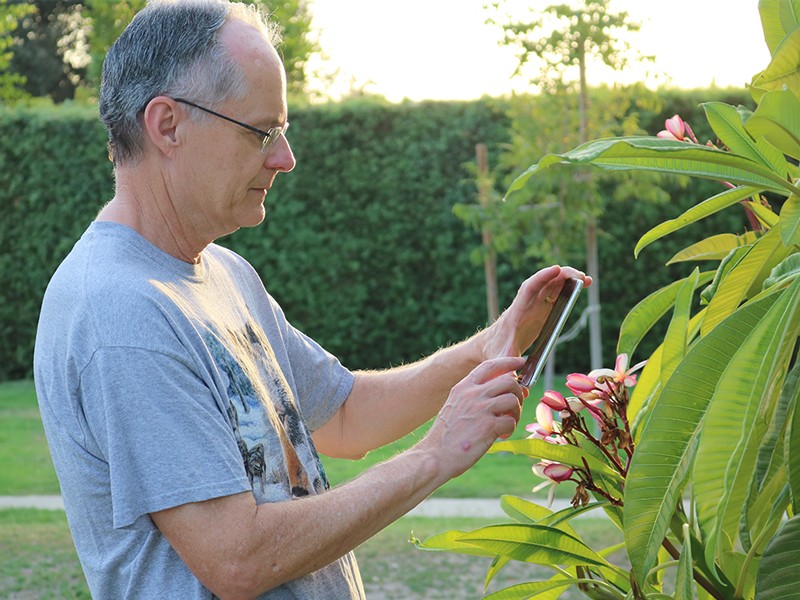
Patrick Gavit snaps a photo of an insect to post on the iNaturalist app.Credit: Lisa Ebiner Gavit
The final category, now gaining in popularity, is co-creation, in which members of the community work together with scientists from the start. Mondardini’s centre advocates co-creation because the scientific literature indicates that it offers the best results for both scientists and volunteers, she says.
Mondardini is working with Sachit Mahajan, a postdoc at the ETH, to co-create a project on indoor air quality. The field is so wide open, Mahajan says, that almost any question of interest to volunteers would yield useful data. He sought interested parties through the Citizen Science Center’s e-mail lists and by word of mouth.
The project’s first meeting, in July, attracted around 20 volunteers, including university students, people with technical backgrounds and families concerned about the air they breathe. Mahajan started off with some icebreakers: attendees paired up to discuss their concerns, then did a short quiz about local air quality. After he had presented some technical details of air pollution and shown off prototype air monitors, the discussion turned to what questions to pursue. Attendees were particularly interested in understanding how pollution varies in different parts of the home.
To maximize findings, sincere volunteer outreach is key, says Mahajan. “You have to make sure that when you are talking to citizens, you’re listening as well.”
People skills
Organizing a large cadre of volunteers might sound daunting, but community-science organizations around the world have plenty of expertise and resources. “If you don’t like interacting with people, you want to have somebody else on your team who’s willing to be the public face of it and has that patience,” says Andrew Durso, a wildlife ecologist at Florida Gulf Coast University in Fort Myers.
Getting to the right volunteers requires an understanding of their desires. Do they want to just drop in with the occasional photo of a butterfly, or are they deeply passionate about the topic? Is the research connected with a hobby, such as identifying birds, or could health or lives depend on the project, as with water-quality monitoring?
Durso knew just where to go when he needed reptile-lovers to identify pictures of snakes. When he was a postdoc at the University of Geneva, Switzerland, his research group was hoping to guide treatment for snakebites with an experimentally verified, peer-reviewed system for identifying snakes from photos3. Durso was already a member of a snake-identification Facebook group and recruited contacts there, who helped to accumulate more than 100,000 snake IDs in weeks.
If a ready-made community doesn’t exist, there are plenty of places to find volunteers, such as online hubs and project aggregators. For example, SciStarter’s membership includes 140,000 users who are actively engaged in projects.
Chris Schaffer, a biomedical engineer at Cornell, and his colleagues needed volunteers to analyse videos of mouse brains for blocked blood vessels, which could be related to Alzheimer’s disease — so they turned the hunt for blockages into a web app, called Stall Catchers. Schaffer has reached out to teachers to introduce the app, so they can use it in classrooms. He’s spoken at community centres and to groups of retired people, for whom the opportunity to help in Alzheimer’s research is a big draw. And he ends every scientific talk he gives with a pitch for volunteers. A core group of about 1,000 observers have made the most significant contributions, says Schaffer.
Community-science participation often skews towards white, educated and affluent demographics4, and scientists seek a more diverse pool of participants. For example, when Pauly wanted biodiversity data from under-sampled parts of Los Angeles, he needed volunteers in areas where socio-economic status was often lower, and engagement in science less prevalent, than is typical for users of the iNaturalist app.
Pauly and his colleagues contacted local organizations, such as nature centres and libraries, as well as teachers. “Social media was one of the best ways” to spread the word, Pauly says. He made sure to tag posts with the specific regions he was interested in, so residents there knew their participation was wanted. These people knew about mini habitats, such as a roadway embankment or a sliver of turf behind a market, that the professional scientists would never think to check.
Jacqueline Goldin, an anthropologist at the University of the Western Cape in Cape Town, South Africa, led volunteer recruitment for a project to monitor well-water levels in Limpopo, the country’s northernmost province. The researchers wanted a broad sample of participants in terms of both age and gender. “It’s tricky, and you’ve got to be careful,” she says. Asking local authorities for names often yielded a list of the most powerful people in villages. The researchers probed deeper for names of women and others who collect water, and the first group they recruited helped to find others to join the project.
People management doesn’t end with recruitment. Grützner now has 12,000 echidna-hunting volunteers, and some occasionally call him up to chat. He enjoys the interactions, but says, “It does use quite a bit of time.”
Volunteers must derive something positive from participation, says Mondardini. That might take the form of learning a skill, interacting with others with similar interests or having discussions with professional scientists.
Sharing results is the most crucial element of giving back. “The sure-fire way to watch people drop out of a project is to not communicate any of the work back to them,” says Phillips.
Beyond that, many volunteers are quite happy with inexpensive rewards, such as digital badges or occasional get-togethers. Again, it helps to know one’s audience. The top participants in Durso’s snake-identification project were delighted to receive a free natural-history book. His colleagues were surprised by the positive response, but Durso says it was the perfect prize for natural-history-obsessed folks.
Although most projects don’t pay volunteers, opinions on remuneration vary. Goldin is against it; she says it creates a precedent such that people will expect payment for future projects. Her well-water monitors have never asked for payment, but as a gesture of goodwill, the researchers regularly provide a food hamper worth about 250 rand (US$14).
There are instances when monetary compensation could make sense, says Lisa Rasmussen, a philosopher at the University of North Carolina in Charlotte. For example, if scientists are working with marginalized populations who can’t afford to participate for free, then it might be appropriate to pay them.
Data quality control
Paying attention to the participants shouldn’t detract from attention to the data, of course. “Citizen science can easily be criticized [in] that the data quality is not good, but look at ‘real’ science,” says Balázs, pointing to well-known reproducibility problems.
Scientists can ensure that data are as accurate as possible by acting before, during and after the collection process5. It starts with “super clear protocols”, says Cavalier. Those instructions must also clearly reflect the study’s stated goals, says Stan Rullman, director of research at the Earthwatch Institute, a non-profit environmental-research funder based in Newton, Massachusetts. If volunteers can see a clear line linking the measurements they make to the research objectives, “they’re going to collect better data”, he says.
Matthew McCurry, curator of palaeontology at the Australian Museum in Sydney, layers several quality-control measures into his online Date a Fossil project. He aims to estimate dates for palaeontological sites, starting with McGraths Flat, a Miocene-epoch (between 5.3 million and 23 million years ago) site with well-preserved fossils northwest of Sydney, as a test case. He has tons of electron-microscope images of the split faces of rocks from the area and needs help to spot microfossils that would give an independent indication of the site’s age.
When it comes to actual fossil-spotting, one volunteer’s analysis isn’t enough: each image must be flagged by several volunteers who think a fossil is present. This statistical approach is one of the most common methods to ensure accuracy, says Mondardini.
An expert palaeontologist then checks the potential microfossils. “It greatly cuts down the amount of work, to the point that it makes this project feasible,” McCurry says. So far, the study data support a date during the Miocene, and he hopes to extend this dating technique to other sites.
With proper quality control, amateur data can be of a high standard — often even the best data available. Durso, for example, compared snake identifications by volunteers, professional herpetologists and a machine-learning algorithm. “Amateurs are really good at identifying snakes,” he says. “They’re better than experts.” In fact, the volunteers found more than a dozen misidentified snakes in his first test data set. Both amateur and professional human herpetologists also bested computers, although the algorithms are improving.
In the best community-science projects, everyone gets something out of it. That’s how it was for Patrick Gavit, a Los Angeles resident who snapped photos of an invasive African five-lined skink (Trachylepis quinquetaeniata) that caught Pauly’s eye6. Gavit joined forces with Pauly and his museum colleagues to approach his neighbours for help in spotting the animals, and the team ultimately trapped all 67 of them.
Participating gave Gavit “a tremendous amount of satisfaction”, he says. A biochemist by day, Gavit enjoyed moonlighting as a volunteer skink scientist. “I consider myself an amateur naturalist. To be involved in a science project related to nature is even more thrilling.”
[ad_2]
Source link


