


Q&A with Conservation AI Hub’s Grant Hamilton

[ad_1]
- Conservation AI Hub uses drones and artificial intelligence to detect koalas that survived the Australian bushfires of 2019 and 2020.
- The initiative is now working with communities in Australia to train them on using the technology by themselves.
- Director Grant Hamilton says it’s imperative to make technology more accessible so that more citizens can engage and participate in global conservation efforts.
Conservation apps have emerged in recent years as an efficient and cost-effective way to get citizens to monitor and document wildlife across the world. But an Australian initiative is going one step further.
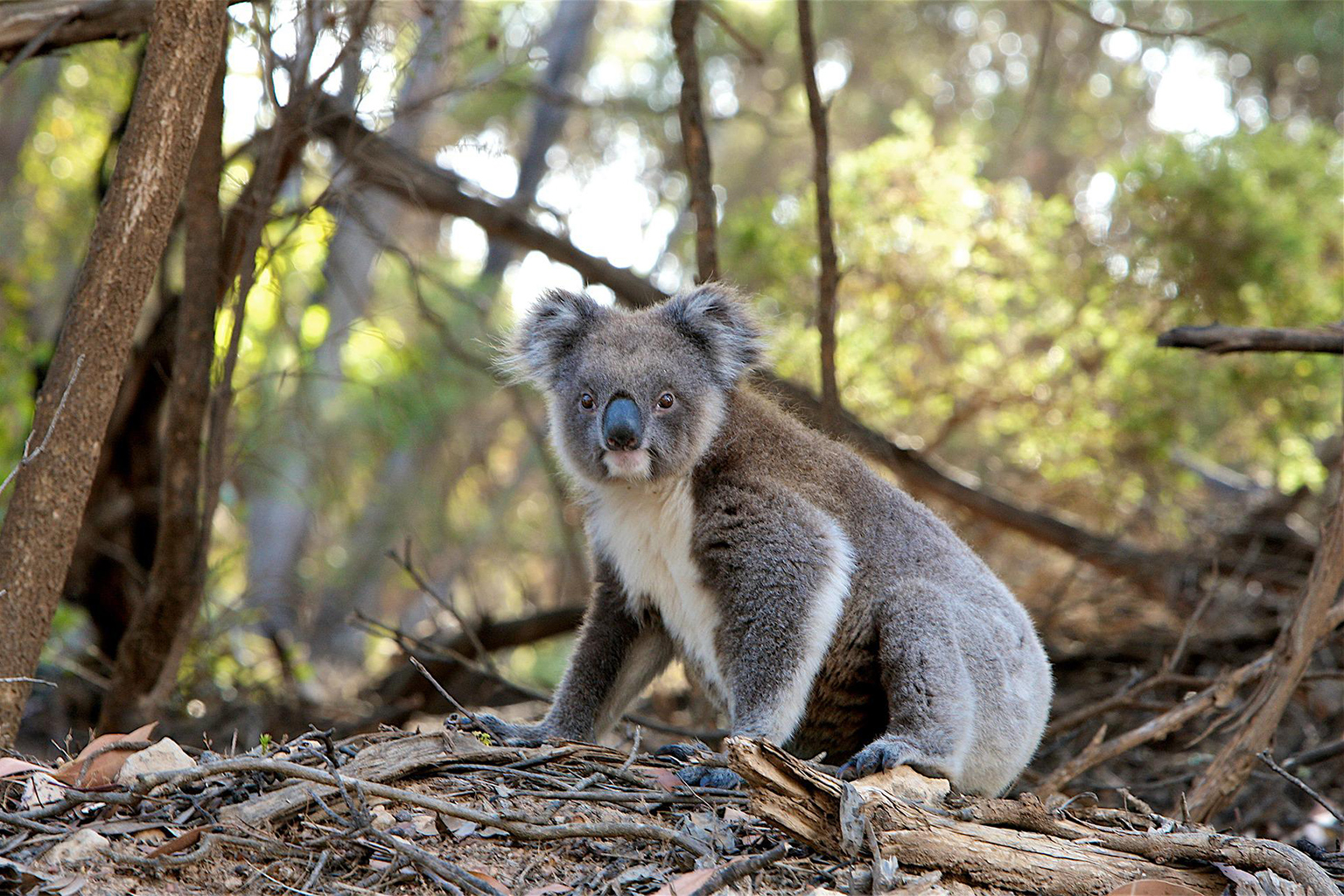
In a bid to detect and save the country’s dwindling koala (Phascolarctos cinereus) population, Conservation AI Hub has, since the beginning of this year, been training volunteers in the state of Queensland to use infrared drones. The goal: to find koalas that are usually found curled high up in the trees. The initiative by the Queensland University of Technology (QUT) began earlier, in August 2021, with a small team operating the drones. They then analyzed the images collected using artificial intelligence algorithms. But as the project scaled up, the need to rope in volunteers became apparent.

It’s an urgent mission. The deadly bushfires that blazed through large swathes of Australia in 2019 and 2020 decimated the country’s already vulnerable koala population: a 2021 report by the Australian Koala Foundation found that the country lost 30% of its koala population in the past three years. Earlier this year, the Australian government declared the species endangered in much of eastern Australia.
“The situation is pretty dire,” Grant Hamilton, director of Conservation AI Hub, tells Mongabay in a video interview. In the face of the climate and biodiversity crises, he says, it’s more essential than ever to get citizens involved in conservation efforts. And getting them access to and acquainted with technology is a good place to start.
Mongabay’s Abhishyant Kidangoor spoke with Hamilton on the work done by Conservation AI Hub, the role of conservation technology in a climate-ravaged future, and why it’s up to the common citizen to stand up for the planet’s biodiversity. The following interview has been lightly edited for style and clarity.
Mongabay: To start with, could you tell me where your interest in wildlife conservation stemmed from?
Grant Hamilton: I grew up in a small town in northern New South Wales in Australia, and I was always out in nature. At the time that I grew up, it was very much a conservation-minded kind of area. There were some particularly large protests when I was young that had to do with logging. And that really made an impact on me. Frankly, for a lot of people from my generation, there is a strong drive toward conservation that hasn’t necessarily been translated through to the political will globally. But there are still a lot of people who are very devoted to it.

Mongabay: How did technology come to play a part in your work?
Grant Hamilton: I am a quantitative ecologist which means that I often create models to understand ecology. In the case of threatened species, one of the important things is simply finding where they are, and counting how many of them there are. Fundamentally, if we can’t estimate how many animals there are of a particular species, then we don’t know if the numbers are going down or up. We don’t know if the time, energy and money we are investing into managing them is effective or not. And it’s surprisingly hard to find things. For koalas, in particular, which is where I did a reasonable amount of this work, they are really difficult to see. They are up in a canopy. Humans are down on the ground, looking through binoculars. It’s a real challenge. There are some amazing people who do it really quite well. But even when they are doing it well, they are only getting to spotting two koalas for every three that are out there. And that’s quite a large error rate. So part of my interest in technology was about how we think about doing things at a large scale and doing it more efficiently.
Mongabay: How do you think technology is faring when it comes to wildlife conservation?
Grant Hamilton: I think it’s on the increase. There is a recognition of the advantages. I think people are increasingly recognizing that the scale of the problem is not going to be solved simply by traditional tools. While I will never say that these technologies are the only solution, it would not be smart to ignore them. And it makes a lot of sense to try and expand them to find the areas where they are most practical, most efficient and can save us money.
Mongabay: Could you tell me how Conservation AI Hub works and how your team uses technology on the ground?
Grant Hamilton: Fundamentally, it is a data portal connected to a set of AI algorithms. The partners that we are working with will collect data in an appropriate way using appropriate technology. So that might be using camera traps, or it might be using drones, and they will feed that through to us. Then, we either use the algorithms that we have already developed, or we develop new algorithms, and work with those partners to get that data back to them. For example, after the Black Summer bushfires in Australia in 2019 and 2020, we did some work in Kangaroo Island in South Australia, where we were helping them to use drones to be able to detect koalas. Increasingly, we are also using camera traps.
Mongabay: What is the workflow after the data is collected?
Grant Hamilton: What happens next is that we run the data through an artificial intelligence algorithm to look for koalas. It is possible to get people to look through thermal imagery to look for koalas, but the challenge is that we might be looking at over 50 or 60 or 80 hectares [120-200 acres] at a single time and that’s an enormous amount of thermal imagery data. So we use artificial intelligence to scan through all the data really quickly to be able to find the koalas. We then have a quality assurance phase to make sure that we are not getting too many false positives [koala sightings that aren’t actually koalas]. We then share the analyzed data so that it can be for everybody to benefit from, but only if it is appropriate.
Mongabay: What are the cases where sharing the data is not appropriate?
Grant Hamilton: There might be areas where perhaps Traditional Owners [Indigenous Australians with a spiritual or cultural connection to the land] don’t consider that it’s appropriate for us to share data. Sometimes with threatened species, you don’t actually want to let people know where those threatened species are. So, in the near term, there might be an embargo on such data, but the intention is always going to be to share that data.
Mongabay: Could you give me a ground-level example of a project Conservation AI Hub is working on currently?
Grant Hamilton: At the moment, what I am really excited about is one of the projects that the Conservation AI Hub is involved with, which is called the WildSeek. We are working together with Landcare Australia [a grassroots environmental organization], and we are training groups of volunteers to fly drones to collect data, which they send through to my research group at QUT. We then use artificial intelligence to detect koalas, and we deliver the detections back to them. As far as I know, this is a world first, this kind of training and application. The powerful and exciting thing about this is it’s the people who manage the land who are actually collecting the data, and then receiving the data back to help them manage better. We are aiming to have five groups on board within the next couple of months, but I see no reason why within two or three years, we may not have 20. Essentially if you are looking at how to scale conservation, I believe this to be a very effective model.
Mongabay: What has the impact on the ground been like?
Grant Hamilton: It’s relatively new. We launched at the beginning of the year. For now, the model is the exciting bit — the model of having volunteers that we are bringing on board to help with this. Often there’s a disconnect between the people who monitor and the people who manage. But what we are doing now is amped-up citizen science which would enable folks on the ground to have better data to be able to manage better. We have one group that we have been working with in Noosa, which is a coastal town in southeast Queensland [state], where there are some really amazing koala habitats. But some of it is quite dense, and it can be quite difficult to get to. So what we have been doing is flying drones on these sites regularly to detect koalas across very large areas where it would have been really challenging for people to be able to do that. The other incredibly exciting thing is, as replanting is going on in that area, we are planning to continually resurvey to determine if koalas are moving into these replanted areas.

Mongabay: Before WildSeek was launched, how was the data collection done?
Grant Hamilton: Earlier, we would be the ones to go out and collect the data. We would send out drone operators from QUT to collect the data, and we would do essentially everything in-house. But it soon became apparent that if you want to scale this up in many countries, sending out a single team of drone operators wasn’t enough. It is a very good proof of concept, but it’s not effective if you want to make broad-scale ground impacts. So that’s how the idea developed to start working with volunteer groups, and to buy the equipment for them and train them so that we can then process the data for them.
Mongabay: What are the challenges you have faced in terms of using technology?
Grant Hamilton: There are a set of hurdles which are going to be issues with any monitoring method you use. That has to do with planning how you fly a drone. Are drones appropriate for the species that you are looking for? Are camera traps appropriate for the species that you are looking for? To fly drones, for example, if you are flying a reasonably sized drone, you need appropriate training. It’s large, and you need to understand what the laws are in your area around flying drones. Being able to fly the drone is not enough. You need to be able to fly it in the appropriate way with an appropriate sensor. And there’s a whole set of constraints around this: the height, the speed, and the size of the organism that you’re looking for. But we have managed to work this out over a number of years for different kinds of species. There is a considerable technical challenge in ingesting data across networks from a long way away. You might get interruptions and you need to make sure that that data still gets there whole. In each step along the way, there are going to be site-specific hurdles. There will always be issues, but that’s part of the fun. And hopefully, we will resolve them in a way that contributes better to conservation.

Mongabay: If you were to chat with someone who develops technology for conservation, what would you tell them are the technological gaps you face?
Grant Hamilton: Drones are just a platform to carry the real thing that we are interested in, and that’s the sensor that collects the data. There are some really amazing sensors currently, but they are very expensive, and some of them are quite heavy that you might need to fly them in a helicopter, rather than on a drone. So what I hope and would expect to see coming along is more high-resolution and more lightweight sensors. But low cost is going to be a very important thing, particularly if we are talking about empowering citizens to go and collect data. Finding ways to enable people to engage with this, and really to democratize conservation is really important. Partly, you are always going to have to work with folks like us, because the development of quantitative analytical tools and machine-learning tools takes a fair bit of training. But the idea is about data collection, and using people who are out there. There are a lot of people passionate about conservation, and they want to get involved. So marrying the technology with those people who want to help will be an incredibly important thing for the folks who make this technology. If they can step up in that way, that would be a huge boost.
Mongabay: Where do you see Conservation AI Hub going from here?
Grant Hamilton: We want to help to save the world. People are focusing, quite rightly, on the fact that we are facing a climate crisis. But we are also facing a biodiversity crisis. What people don’t often recognize is that when biodiversity goes, so do we. I would argue that ecosystems have an innate right to persist. It shouldn’t all be about the utility for human beings.
What we are trying to do is to get that first step of monitoring, so that we can point out where the problems are and determine if the management taking place is being done effectively. We want to be able to hold up those areas where things are being done badly. It’s going to be up to us common citizens to go out there and stand up for biodiversity.

Mongabay: In a rapidly heating world which is also facing a biodiversity crisis, what role do you think technology can play?
Grant Hamilton: There has been a set of skills around wildlife observation and conservation. There’s a learning curve, which is potentially hard for people. If we can lower that bar to enable them to collect data in their surrounding environment, in the place where they are invested in, the area where they live, if we can lower that bar to allow them to help, that has to be a good thing. That is partly what conservation technology is going to do. It is going to allow us to record and see where things are going wrong. Perhaps occasionally, we might get wins and we might see things that are going well and we might learn from those successes. But certainly, if we allow people to engage with conservation technology, help them to understand what it means — that awareness, I believe, has to be a good thing for biodiversity. Especially if it translates to the political process and helps to put pressure on politicians, organizations and companies to do better.
Article published by Hayat
[ad_2]
Source link


